

Composite Decking Contractor in Connecticut
Serving Fairfield County & Western Connecticut
PBL Construction installs composite decking throughout Fairfield County and western Connecticut — planning, framing, and finishing new decks and qualified resurfacing projects with products matched to your home and how you'll use the space.
Trex · MoistureShield · Deckorators · CT HIC.0653437
Why homeowners choose composite decking
Composite decking blends wood fiber and engineered resins into a board that behaves differently from either raw material. For many Connecticut homeowners, that difference is what tips the decision: a low-maintenance surface that resists moisture, splintering, and fading better than wood, without the ongoing sealing and staining that a natural-wood deck demands.
It is not automatically the right choice for every project, and we don't treat it as such. The decision between composite and pressure-treated wood comes down to how you'll use your deck, your tolerance for maintenance, and your budget — all of which we help you weigh before committing to a material.
Composite decking brands PBL installs
We work with a range of composite decking and railing products so the material is matched to your appearance, performance, and budget goals — rather than forcing a single line onto every project.
Trex
A widely used composite decking and railing line offering a broad palette of colors and a low-maintenance, wood-like surface. Trex is a common choice when a homeowner wants a wide selection of finishes and a proven, mainstream composite.
MoistureShield
Composite decking engineered to resist moisture, a practical choice for ground-level decks and shaded Connecticut sites where standing water or damp conditions are a concern.
Deckorators
Composite decking focused on performance and durability, with a range of surface colors and finishes for homeowners who prioritize a hard-wearing, low-maintenance surface.
Material selection, installation requirements, and any applicable manufacturer warranty terms should be reviewed for the specific products chosen for your project.
Composite deck installation details
A composite surface only performs as well as what's beneath it. The framing, spacing, and fastening details below the boards are what keep a composite deck flat, solid, and straight for years.
Structure & Framing
Composite decking is installed over properly sized footings, beams, and joists — the same structural foundation any lasting deck requires, regardless of the surface material.
Joist Spacing & Blocking
Joists are laid out to the manufacturer's spacing recommendations for the specific board, with blocking added to stiffen the frame and keep the surface supported across its full length.
Hidden Fasteners
Composite boards are commonly secured with hidden fasteners or clips matched to the product, leaving a clean, fastener-free surface without exposed screws.
Picture-Frame Borders & Square Edge
A picture-frame border or square-edge finish gives the perimeter a crisp, finished line, hiding cut ends and framing the field of the deck intentionally.
Fascia, Railing & Stairs
Fascia trims the outer edge, while railing and stair runs are coordinated to match the decking and carry the same low-maintenance, finished character.
Flashing & Joist Tape
Flashing directs water away at the ledger, and joist tape helps protect the top of the framing — details that reduce moisture damage over the life of the deck.
Composite decking has specific framing and fastening requirements that vary by product and manufacturer. We build each deck to those requirements — and to the conditions of your specific site — rather than applying a single universal framing spec to every project.
New composite deck, or composite resurfacing?
A brand-new composite deck is framed and built from the footings up, giving you full control over the size, layout, and materials. If your existing deck's structure is still sound, resurfacing the top with composite can be a more cost-effective way to get a low-maintenance surface without rebuilding what doesn't need it.
The deciding factor is always what's beneath the surface. We inspect the footings, framing, ledger, and joist spacing before recommending one path or the other — a structure that has deteriorated or needs correction is better replaced than resurfaced.
For a fuller breakdown of how retained, removed, and newly installed work is set out in a proposal, see the replacement and resurfacing section on our custom decks page.
Explore Custom Deck OptionsNew Composite Deck
Built from scratch on new footings and framing — the right fit for creating a new outdoor space or substantially changing the footprint of what's there.
Composite Resurfacing
May be appropriate when the existing structure is sound. You get a new composite surface without rebuilding the framing that doesn't need it.
Composite vs. pressure-treated wood
Neither material is universally better — each suits different priorities. Here's how they compare in practice, so you can decide based on how you'll actually use the deck.
Composite Decking
- Less routine maintenance than wood — no required annual sealing or staining.
- Resists splintering, moisture, and fading better than natural wood.
- Generally higher upfront material cost than pressure-treated wood.
Pressure-Treated Wood
- Generally more cost-effective up front, and a time-tested classic look.
- Requires routine staining and sealing to protect and refresh the surface.
- Naturally warmer character that develops with age, which many homeowners prefer.
We'll help you weigh these tradeoffs against your budget and how you plan to use the space — and recommend the material that fits best, not the one that's easiest to default to.
Real composite deck projects
Composite decks built by PBL across Fairfield County and western Connecticut — each with its own completed project detail.
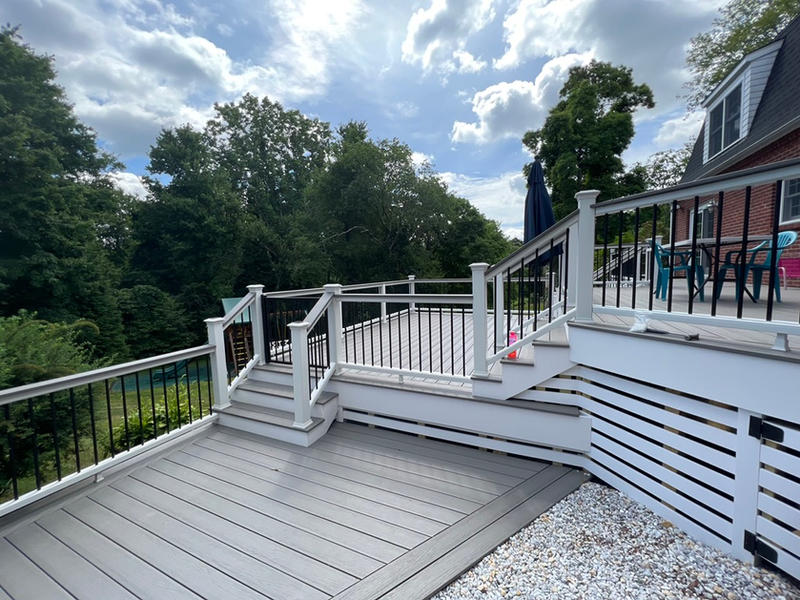


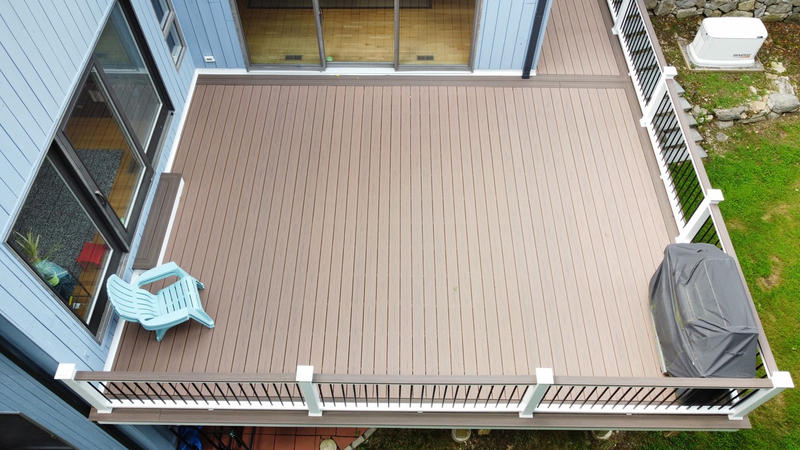
Composite decking throughout Fairfield County & western Connecticut
PBL Construction LLC is based in Sandy Hook and serves homeowners throughout Fairfield County and western Connecticut. The full list of communities we cover lives on our service areas page.
If you're planning a composite deck in Wilton or composite decking in Waterbury, we'd welcome the chance to review your project. See the full service areas we cover.
View All Service AreasBuild in Confidence
We build to the requirements of your town and the specifications of your chosen product — not a generic assumption about how decking is done statewide.
Request a ConsultationComposite decking FAQ
How much does a composite deck cost?
Composite deck cost depends on size, height, framing, site conditions, product selection, railings, and any required approvals. Rather than quote a fixed price, we review your site and goals and provide an itemized proposal once the scope is clear.
Is composite decking better than wood?
It depends on your priorities. Composite typically requires less routine maintenance and resists moisture, splintering, and fading better than wood, but it usually costs more up front. Pressure-treated wood is often more cost-effective and offers a classic natural look. We recommend based on budget, appearance, and how you'll use the space.
Do composite decks need to be sealed or stained?
Composite decking is not designed to be sealed or stained the way wood is. It's engineered for low-maintenance outdoor exposure — occasional cleaning to remove debris and mildew is generally all that's needed to keep it looking its best.
Can I resurface an existing deck with composite?
Sometimes. Resurfacing can work when the underlying framing, footings, and connections are still sound. When the supporting structure has deteriorated or needs correction, replacement is the more appropriate path — we evaluate the deck before recommending either route.
Does composite decking get hot in the sun?
Like most deck surfaces, composite boards warm up in direct sun, and darker colors tend to retain more heat than lighter ones. Color choice, shade, and orientation all play a role, and we can discuss these factors when selecting a board for your site.
What colors and finishes are available?
Composite decking is available in a wide range of colors and grain patterns, from warm wood tones to cooler grays and contemporary finishes. We'll help you narrow the options against your home's exterior and the look you're after.
How long will a composite deck last?
Composite decking is engineered for long-term outdoor exposure, but lifespan varies with product, installation, exposure, and use. Manufacturer warranties differ by product line, and we recommend reviewing the specific terms rather than relying on a single blanket figure.
Does a composite deck need a permit?
Deck projects often require building permits, zoning review, and inspections, but the exact requirements vary by town and depend on the deck's size, height, and how it attaches to the home. We help coordinate the applicable planning and permitting process for your property.
Can you match the railing to the decking?
Yes — many composite decking lines offer coordinating composite railing systems, and we can pair the surface, railings, fascia, and stairs so the finished deck reads as one cohesive design.
Ready to explore a composite deck for your home?
Tell us about your outdoor space and we'll walk through the right material and design for it.